How to Cut Carrots into Flower Shapes (Nejiri Ume)
Your folders
Your folders
Total: 45
Servings: 1
Ingredients
Export 1 ingredients for grocery delivery
Instructions
Step 1
Peel 1 carrot. Next, you'll need a vegetable cutter in the shape of ume (a Japanese plum blossom). Plum blossom petals have a rounded and smooth tip, while cherry blossom petals have a notched or split tip.Nami's Tip: Use a large carrot with a diameter equal to or slightly larger than your vegetable cutter. This ensures you get full, clean decorative shapes every time.
Step 2
For the beginner method, slice the carrot crosswise into coins about ¼ inch (6 mm) thick—just the right thickness for using a vegetable cutter.For the advanced method, slice the carrot slightly thicker, about ½ inch (1.2 cm). The extra thickness gives you more depth to carve detailed flower shapes for Nejiri Ume.
Step 3
Punch out plum flower shapes from the carrot slices with a vegetable cutter. Your simple flower carrots are now ready to use, or you can carve them further with a knife using the advanced method. Nami's Tip: Don't waste the carrot scraps! Mince them and add to Spaghetti Meat Sauce, Japanese Fried Rice with Edamame, or soups.
Step 4
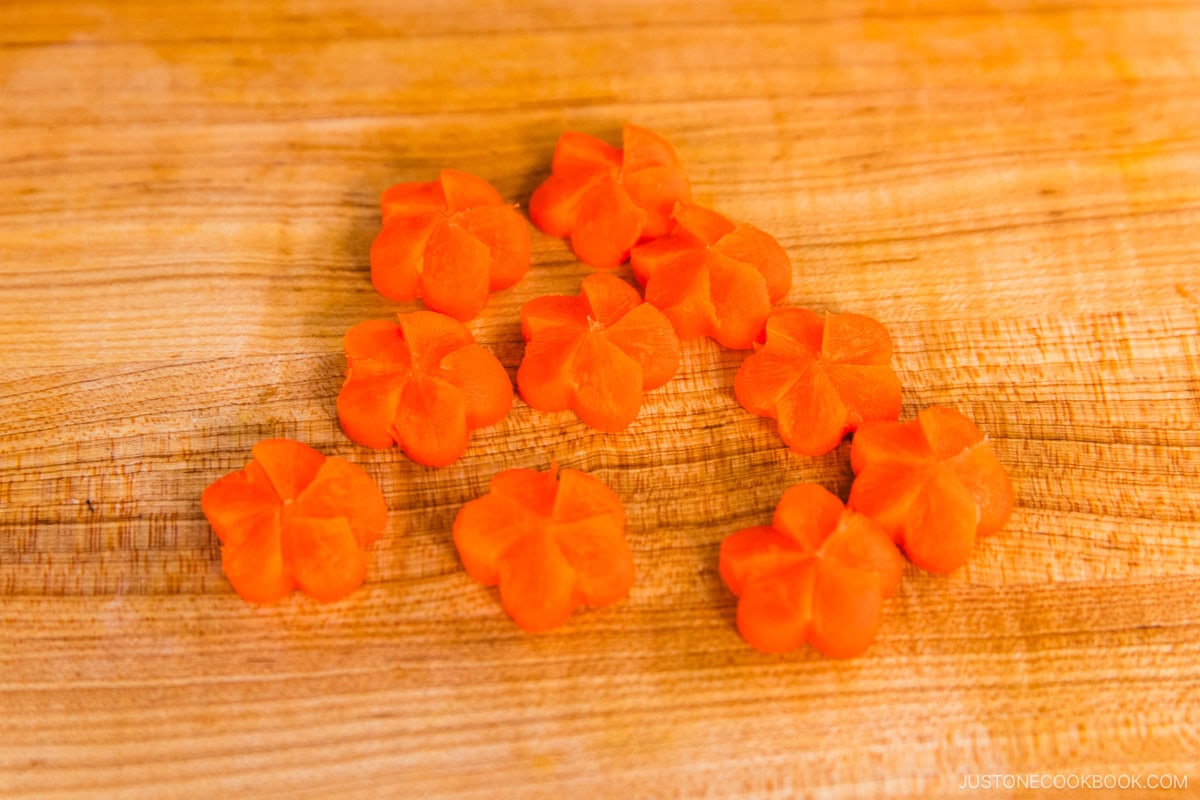
Punch out plum flower shapes from the carrot slices using a vegetable cutter. Then, using the tip of a knife, cut small slits between each pair of petals to define the shape. Nami’s Tip: I make a ⅛-inch (3 mm) deep cut between the petals—starting where the petals meet at the edge and stopping at the center of the flower.
Step 5
Now, shave the petals to create a more realistic flower shape. Place your knife blade at the center of a petal and angle it slightly. If you're right-handed, cut diagonally toward the left, shaving a thin wedge of carrot toward the slit you made earlier. Repeat with the other petals.
Step 6
This extra carving step might seem tedious, but it really brings the flower to life—perfect for festive presentations and osechi plating.
Step 7
Blanch them in boiling water until tender, about 3–5 minutes, depending on thickness.